Changes in Soil Moisture
Some soil types expand when they absorb moisture and shrink as they dry.
These changes may affect foundation support.
A building's foundation transfers structural loads into the supporting ground.
When that ground moves or loses its supporting capacity, the foundation may experience settlement, rotation, or other forms of movement.
Suspected movement affecting a load-bearing foundation should be assessed by a qualified structural engineer or appropriately qualified foundation specialist before repair methods are selected.
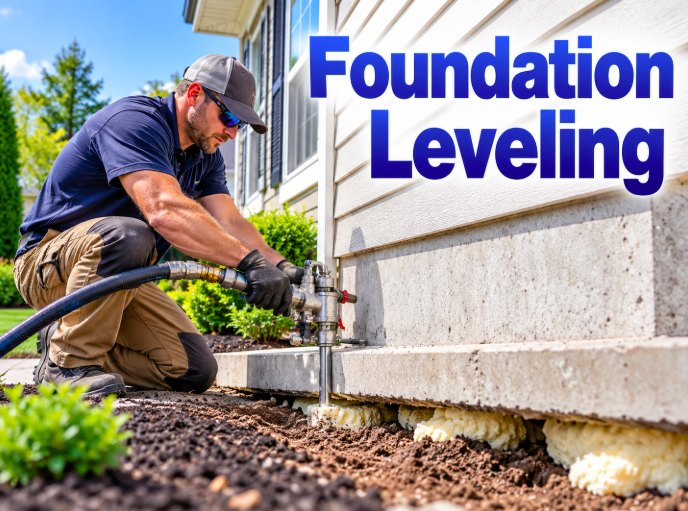
Unlike an ordinary patio or sidewalk slab, a building foundation is part of a structural system.
For this reason, foundation leveling requires a different approach from routine concrete slab lifting.
Torrance Concrete Leveling helps property owners understand the importance of identifying foundation settlement and determining the appropriate next steps.
Foundation movement can develop from a combination of soil, water, construction, and loading conditions.
Some soil types expand when they absorb moisture and shrink as they dry.
These changes may affect foundation support.
Buildings constructed over inadequately compacted fill may experience differential settlement as the ground compresses.
Water movement can disturb or remove supporting soil in certain conditions.
Leaks beneath or near foundations can change soil moisture and support characteristics.
Water accumulating near the foundation may contribute to soil instability, depending on site conditions.
Building additions, major renovations, or other structural changes can affect how loads are transferred into the ground.
Foundation problems do not always produce obvious exterior damage.
Potential warning signs include:
These symptoms are not conclusive evidence of foundation settlement.
Other construction, moisture, and material conditions can produce similar signs.
A structural evaluation is necessary to determine the cause.
Ordinary concrete leveling generally focuses on slabs that are not intended to carry major structural loads, such as certain driveways, patios, and walkways.
Foundation leveling may involve supporting or adjusting structural elements responsible for carrying building loads.
The forces, risks, and engineering requirements can be substantially different.
Techniques suitable for lifting a sidewalk cannot automatically be applied to a building foundation.
Differential settlement occurs when one portion of a foundation moves differently from another.
This movement may produce uneven floors, cracks, or distortion in building elements.
A building may settle relatively evenly without developing the same degree of distortion associated with differential movement.
Even settlement can still require evaluation depending on its magnitude and cause.
A slab-on-grade foundation can be affected by changes in supporting soils.
Repair options depend on its structural design and the extent of movement.
Movement near a foundation perimeter may involve supporting soils, footings, drainage, and adjacent site conditions.
A structural assessment helps determine which elements are affected.
Our process
Cracks, floor elevation differences, and apparent movement are recorded.
Surface water, downspouts, grading, irrigation, and other possible moisture sources are examined.
A qualified professional establishes whether the movement affects load-bearing foundation elements, nonstructural floor slabs, or both.
Possible structural repair approaches may include underpinning, engineered support systems, soil stabilization, or other methods appropriate to the specific foundation.
The correct approach must be determined from the building's structural requirements and site conditions.
When structural intervention is required, engineering recommendations, permits, and applicable inspections should be addressed before work begins.
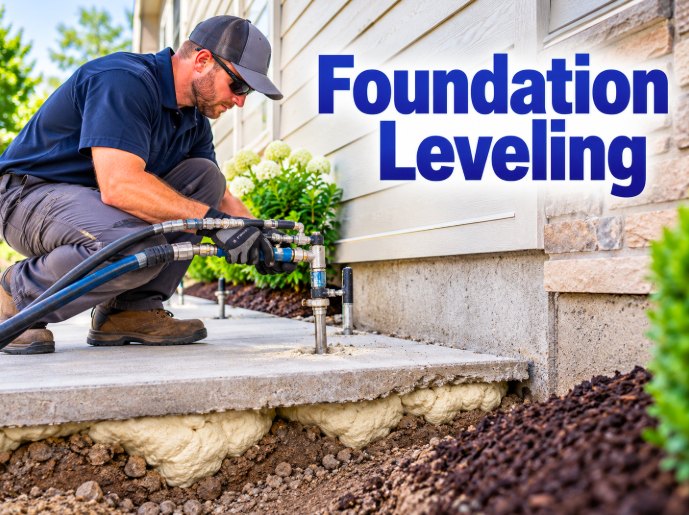
Specialized polyurethane injection may be used in certain geotechnical or concrete stabilization applications.
However, it should not automatically be treated as an acceptable method for lifting a load-bearing building foundation.
Product capabilities, structural loads, soil conditions, and the foundation design must be evaluated.
Where structural foundation movement exists, repair decisions should follow qualified engineering guidance.
Foundation settlement repairs should consider whether water is contributing to the problem.
Poorly directed runoff, leaking plumbing, or excessive irrigation may continue to affect supporting soil even after a structural repair.
A complete repair strategy may therefore include appropriate water-management improvements.
Structural repair does not always require complete foundation replacement.
In some situations, engineered reinforcement or underpinning can address specific deficiencies.
Other conditions may require partial reconstruction or more extensive work.
The decision depends on the foundation's condition and engineering assessment.
Foundation repairs can affect the building and connected systems.
Proper planning may require consideration of:
These factors are particularly important when a repair involves actual structural lifting.
Pricing
Typical range: $2,200 – $12,500
The prices below apply to stabilizing and lifting settled slab-on-grade concrete. Structural foundation repairs such as underpinning or engineered support systems are quoted separately, after a qualified engineering evaluation.
Prices are typical 2026 polyurethane foam leveling ranges for Torrance and the Los Angeles area, based on moderate settling (1–3 inches). You get an exact written quote after a free inspection.
Try the Price Calculator Get an Exact QuoteFAQ
Answers to common questions about foundation leveling in Torrance. Have a question we didn't cover? Call (323) 471-4153.
Some foundation systems can be stabilized or adjusted using engineered repair methods, but not every foundation is suitable for lifting.
No. Structural foundation repairs require assessment of building loads and foundation design.
No. Cracks can develop for several reasons. Their significance must be evaluated in context.
If a load-bearing foundation is suspected of moving, an independent structural engineering evaluation is an appropriate starting point.
Stabilizing and lifting settled slab-on-grade concrete typically costs $2,200 to $12,500, depending on the area and lift needed. Structural foundation repairs, such as underpinning or engineered support systems, are priced separately after a qualified engineering evaluation.
If you suspect that your foundation is moving, identifying whether the issue is structural or limited to adjacent concrete is essential.
Call Torrance Concrete Leveling at (323) 471-4153 to discuss your concerns and the appropriate evaluation process.
Structural foundation assessment and repair should be performed by professionals qualified for the specific work involved.
Call or text(323) 471-415320913 Anza Ave, Torrance, CA 90503